

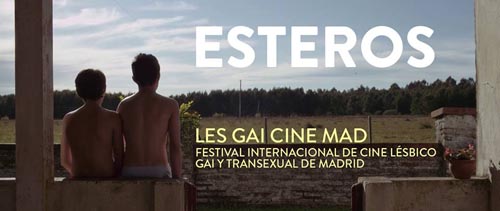
By Manuel Betancourt
Two youngs boys in rural Argentina bond in ways that suggest a budding sexual
attraction. Comfortable in their own bodies and equally at home sharing a shower as
they are a bed, they eventually part ways only to meet again over a decade later. By
that point, Matías (Ignacio Rogers) seems uncomfortable when seeing his old friend
Jerónimo (Esteban Masturini), not least because while he’s told his girlfriend all about
his idyllic childhood escapades by the Uruguay river, he’d never talked at length about
Jero.
In Esteros, opening Friday, November 18th in Los Angeles and followed by other cities, Papu Curotto’s debut feature (an extension and a reworking of his earlier
short, Matías y Jerónimo, where two young boys witness a hate crime), the palpable
chemistry between his leads is sexy and heartfelt. It adds to the ambiguity of the
relationship between the two: while Jero is openly gay and at ease in his own skin, the
film doesn’t condemn nor victimize Matías’ own discomfort at the attraction he feels for
his longtime friend. Their coming together is treated with a delicate sensuality that feels
reminiscent of Looking—not surprising given Curotto’s admiration for Andrew Haigh’s
work.
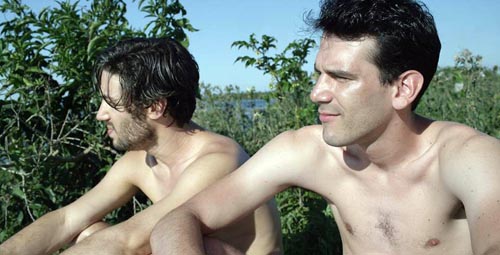
Beautifully showcasing the estuaries of the river that give the film its title and offering us
a move away from the urbane world of contemporary LGBT cinema, Esteros may read
like a well-worn story but its undeniable sultriness makes it a revelation and an
impressive calling card for the first-time director and his screenwriter, Andi Nachon.
Ahead of the film’s screening at New York City’s NewFest, we chatted with Curotto and
Nachon over Skype about the treatment of childhood sexuality in Esteros, the
importance of a rural setting for their drama, and why they’re so excited about their
follow-up project. Check out some highlights below.
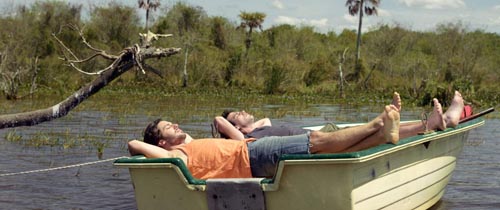
On Turning a Short Into a Feature Film
Andi: The core set piece of Matías y Jerónimo was key to Esteros. What we did in the
short was make it very self-contained and we were able to do that. But then we realized
that that moment of violence wasn’t as important to the story. But there’s obviously a
connection between those boys in the short and the ones in Esteros.
Papu: When we began to work on this project, I had never directed before. Esteros is
my first movie. So to direct Matías y Jerónimo was a way to see how we all worked
together as a crew and to work on the film’s look not to mention figure out how to work
with children. So not only was this my first film but it was my first time working with kids
—and to tackle sexuality with child performers. So producing the short was key to
finding a way to communicate with the young boys.
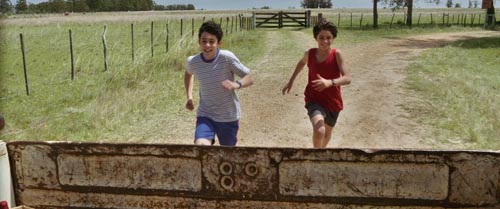
On Working With Non-Professional Child Actors
Papu: Both sets of kids—for the short as well as for the film—are non-professionals. We
did castings not in drama schools or anything but in regular high schools. For me it was
very important to find boys who were from the area so that they could better reflect the
region, you know, in terms of their cadence and their relationship to the space. We
wanted kids who were attuned to the environment of the film. That they wouldn’t have
issues working and playing outdoors—we needed them to have a looseness to them,
when it came to their bodies. It was quite the process. First we did a casting call where
we didn’t tell them what was in the script. When we found some that matched physically
our older actors, we then talked to the parents what the film was about. That’s when a
handful of parents took their own kids out of the running, and others who were still
interested. So we asked them to relay the film’s plot to the boys. We were curious how
they would breach the issue of sexuality to them. At the beginning it was a struggle for
boys we cast but throughout rehearsals we focused on getting them to work on how
they gazed into each other’s eyes. I encouraged to sort of keep their eyes locked in and
to inch ever closer and closer, to the point where they were comfortable staring at one
another while being inches away. I wanted them to not be self-conscious about that
closeness. That was key.

Andi: In addition, Papu worked a lot with them ahead of the shoot. Not just in terms of
rehearsal but he would just spend time with them. Going to the river, playing ball. They
got to know the actors who were playing Matías and Jerónimo as adults. To get them
comfortable around one another.
On Avoiding Gay Stereotypes
Papu: We found both our leading actors through casting calls. Ignacio was an easy get;
Matías was an easier character to cast. Esteban, though, had originally auditioned for
Matías but he ended up as Jerónimo. That was a trickier character to find. We didn’t
want him to fall into the stereotype of a “gay guy.” It’s something that can happen quite
easily in LGBT films. I think sexuality is a key part of one’s identity but it need not isolate
nor define you. When we were building this world and this character, we talked a lot
about how we wanted Jerónimo to move outside of that.
On Looking to Other Movies for Inspiration
Papu: One film that I love and that I just find beautiful is Tomboy. It’s a movie that really
nails childhood sexuality with a simplicity that’s just amazing. There’s Gus Van Sant, of
course. And then, another film that portrays male sensuality really well is Weekend by
Andrew Haigh. I love it and I kept it as a reference in terms of handling the samesex
intimacy in our film. The other film we talked a lot about was Summer Storm for the
way it depicts space and the environment around its characters. We also looked at a
couple of other non-LGBT films that helped us with that, in terms of capturing nature
(we obviously love Malick as he has a great way of doing that).
Andi: We also thought especially about some Argentinean films like The Last Summer
of La Boyita for that as well.
On the Importance of the Film’s Rural Setting
Andi: For me the script was really about that. There were two strands here: there’s the
love story between two boys but it’s key that it happens in this specific context. But
when it comes to Argentinean films, I think it’s also crucial to move away from the urban
world, exploring different areas outside of the city. And in that the landscape was very
important—it’s almost a part of the characters. It’s a place that Matías longs for. It’s a
kind of lost paradise for him. And then these vistas are also breathtaking. The setting
may seem rather plain but it’s so vibrant and alive, and it’s something I think the film
conveys really well.
This interview was conducted in Spanish and has been translated by the author for
Remezcla











Comments